





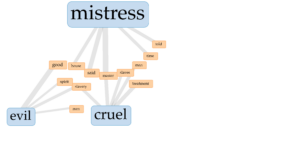
At the outset of my project, I aimed to utilize the Voyant text analysis tools to derive insights from the slave narratives that serve as my data. I had very specific intentions that mirrored other courses I have been taking. In my class, “Antebellum African American Women’s History,” we’ve discussed the presence of slave-holding women in enslaved narratives. We’ve touched on how feminist historians have misrepresented the role of elite white women in the institution of slavery. This discourse inspired my curiosity about what Voyant could reveal in these texts. I decided to use the North American Slave Narratives Collection that was digitized by the University of North Carolina at Chapel Hill. The collection, and consequently my dataset, consists of over 200 documents pertaining to both free and enslaved African Americans. Initially, my limited perspective led me to utilize the Links tool within Voyant. I experimented with various combinations of words, with a particular emphasis on the term “mistress” in my search. However, the outcomes of this endeavor did not yield the results I’d hoped for and assumed would be produced.
This setback motivated me to explore different features within the Voyant software to isolate the term “mistress” in the texts and develop my analysis from that point. I attempted the Reader tool, but the dense readings caused me to lose sight of my project’s objective. I was uncertain about the specific objective I sought to achieve or the manner in which I could utilize Voyant to assist me in identifying it. In hindsight, I attribute this confusion to a misinterpretation of the project’s outcome. After repositioning myself and reconceptualizing my approach to addressing the public-facing elements of the project, I identified my new objective. Rather than attempting to manipulate Voyant’s tools to conform to my preconceived argument, I recognized that investigating where mistresses appeared in the texts would be considerably more feasible.
Following a series of intermittent failures with the Contexts tool, I resolved to experiment with the Collocates tool. During this process, I discovered the existence of preset categories for the collocated words, specifically classified as “positive” and “negative” terms. I explored the terms before returning to the Collocate tool to test a theory. In the tool, I attempted to highlight mistresses as my central term and examine the collocated words identified. I identified occurrences in which the term “mistress” appeared in conjunction with words bearing negative or violent connotations. Subsequently, I utilized the Trends tool to illustrate my findings through graphical representation.


Through experimentation with Voyant, I successfully created a graph that illustrates the occurrences of mistresses in the text in conjunction with negative connotations. This graph does not serve to support my earlier argument. While the findings indicate that white slaveholding women are represented more frequently than what historians have documented, a more thorough analysis of the sources would be necessary to derive any specific conclusions. Nevertheless, I was able to utilize Voyant to demonstrate the mentions of mistresses in the text and their representation within northern slave narratives.
